NASHVILLE & SUMMER NAMM 2003 - Part 1
Ahh, where to start.
There’s a lot to cover and I'm not sure the best way to do it. So I'll
go over the events as they unfolded for the day. I'll put various tidbits
together at the end since on many of them the news developed over several days.
Thursday
Arrived in Nashville late in the evening, about half past 10. Group members Phil Langley (aka lguitars) and Bruce Watson (aka tarbite10) were kind enough to let me crash in their room, since my decision to make the trip was kind of last minute. Met them at the hotel once I arrived.
Never met Phil before, but I'd been talking with him since his
inception of the D-Head late last year. Got
to see the new guitar model he designed in-person for the first time.
It'll be of interest to many of you here (headless and all), and he should be ready to
announce them in a few months. I'd never met Bruce either, but he was fun to talk to as well.
Had a chance to share a few beers and talk Steinberger for a bit before retiring for the evening.
Friday
Both Phil and I had appointments to meet with Richard Akers, Director of Engineering and USA Production, around roughly 9 AM. So we headed out together in separate cars, as I was planning on being there all afternoon and Phil had other business later.
Steinberger production is housed in the Epiphone facility. It's on Massman drive, right next door to the Gibson Custom Shop. The general area is several miles northwest of the Nashville airport in a 60's/70's type industrial park - buildings close together and closer to the street with a few rows of parking in front. There's more parking and space behind the buildings.
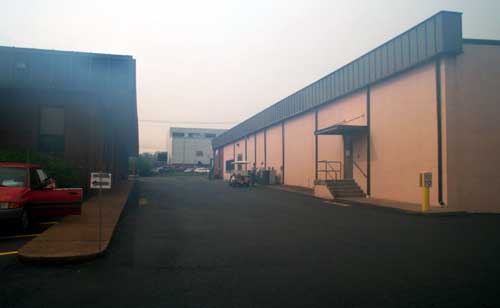
Rear shot of the Epiphone facility.
Offices are on the left, plant/warehouse on the right.
There are two main Epiphone buildings. From the street the offices are on the right and the plant/warehouse to the left. I apologize for the poor photos - the lens was fogging over due to the humidity. Anyway, there's a big parking lot in back and the MusicYo warehouse is tucked in a separate blue building farther in back towards the property line. There are a couple of other smaller buildings here and there, including a storage building (non air conditioned I might add - more on that later). Main entry to the plant is in the back.
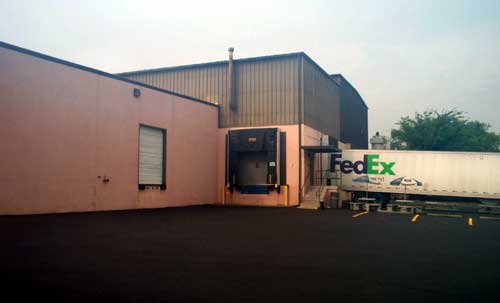
Another rear shot of the
plant/warehouse. Entry is between the loading doors.
When you enter the right side is warehouse/storage. It's climate controlled, and you could see the misters on the ceiling keeping the humidity constant as well. Most of the product is Epiphone, but I did see several MusicYo boxes on the shelves
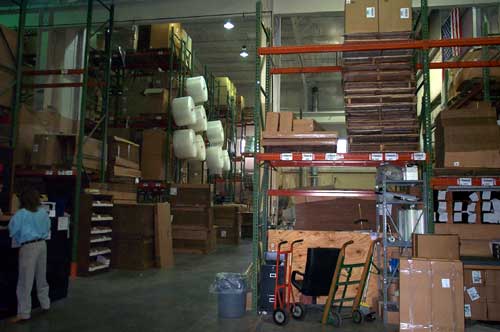
Warehouse side of the factory. Guard desk is on the left.
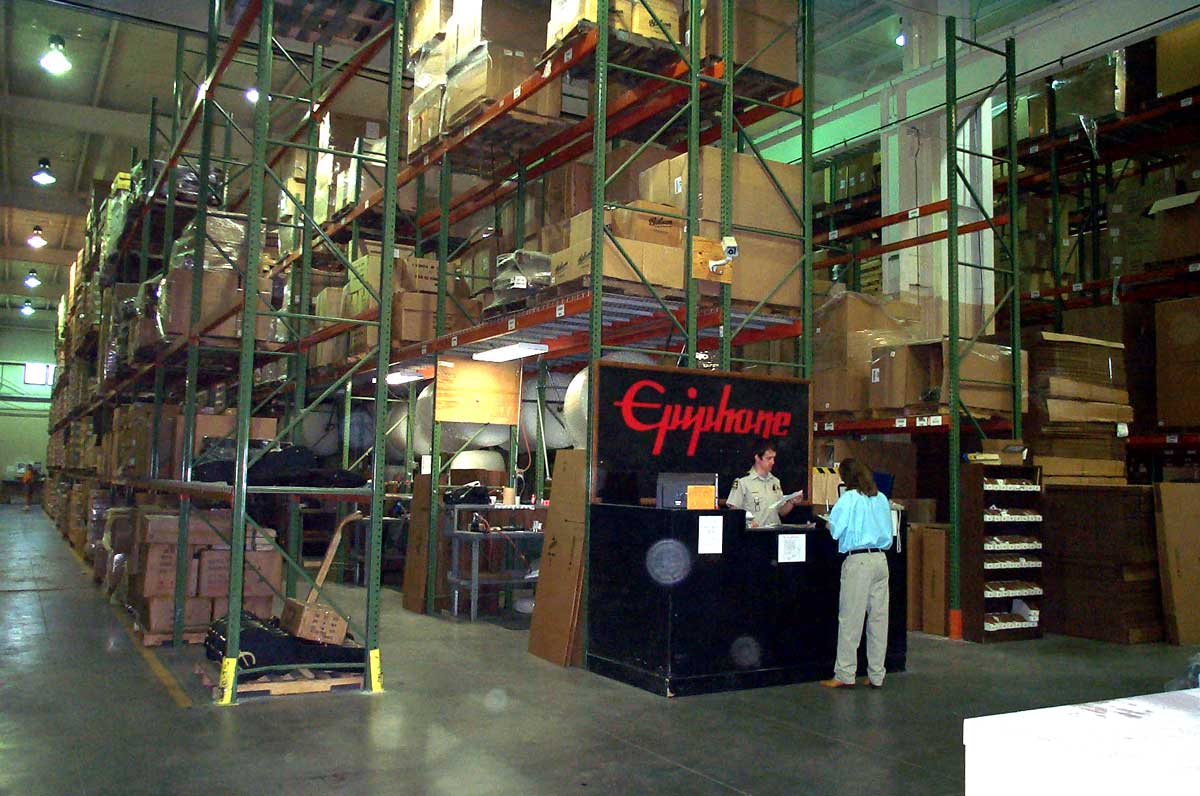
Another shot of the warehouse
with guard desk in center. That's Phil Langley signing in.
Click on image for a larger detailed view.
Just past the guard desk
through an opening on the left on
the left is where the production happens.
I'd guess it's about 1/3 of the facility, and is split up into different
areas. It's not totally open as
there are sometimes walls, shelves or fences separating some of the areas.
The building
has probably gone through a few additions over the years.
We first got to meet Richard
Akers. His official title is Director of
Engineering & USA Production. He's an extremely personable
guy (more on him later) and he escorted us around.
His office is in the back corner next to some prototyping equipment they
use from time to time. As expected
he's got many instruments in his office, including a black GS with Jam Trem
they got off the trailer. He said
he likes
that one a lot. We chatted a little
there, then he showed us the rest of the facility.
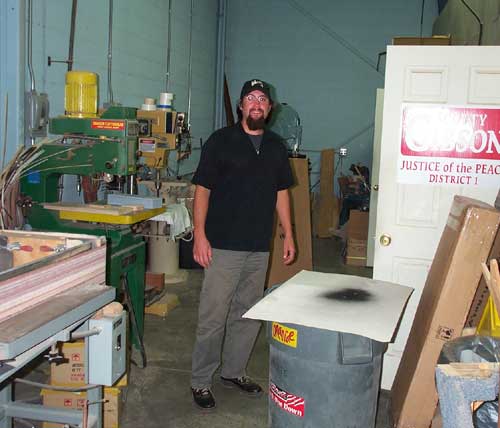
That's Richard Akers, head of Steinberger USA
production.
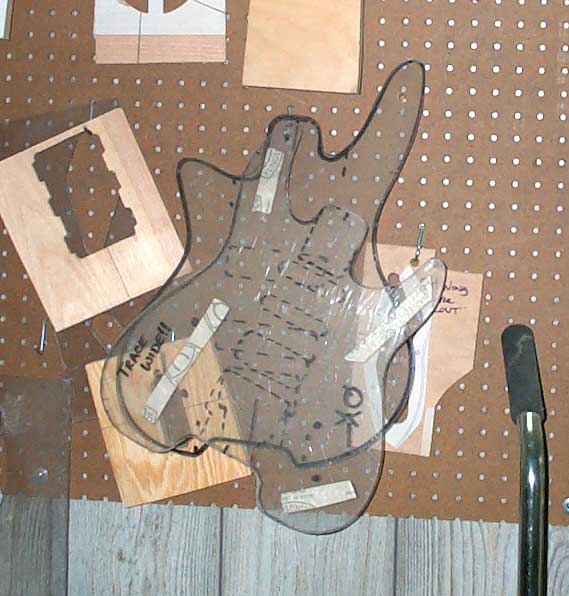
The template archive wall right outside Akers
office. Notice the old GM & XQ router templates.
All the bodies are cut on CNC machines today.
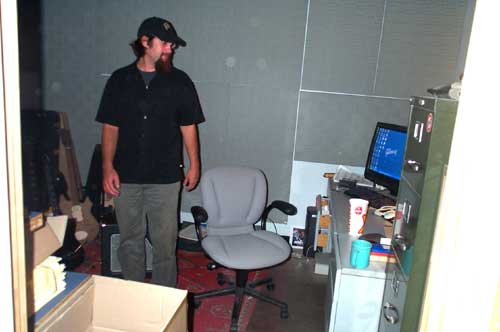
Akers inside his office.
They've got staff assembled into work areas throughout the production floor. We saw the machine where they scan instruments to get detailed CNC drawings - that's where they did the bound M's we sent to them. We got to see the buffing stations, supplies, other assembly areas & offices, etc.
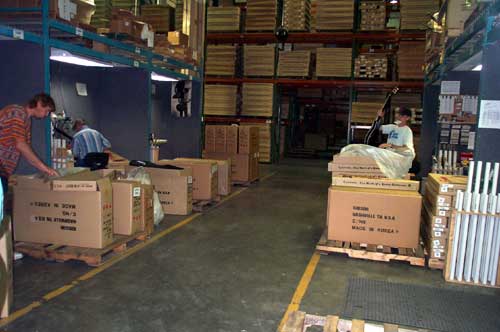
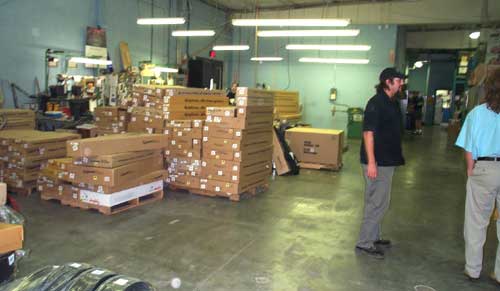
Finished instruments boxed up and ready to be inventoried.
Some will stay in the Epiphone plant, while others will get moved over to
MusicYo.
We ended our plant walk back at the Steinberger production area and met with the USA staff. This currently consists of three guys: Jimmy Ellis (lead person), Dave Mahaffey and Neal Logdahl. They handle all USA production for Steinberger, Kramer and the Epiphone John Lennon models. To a person each was excited about making these weird headless instruments we’ve come to enjoy. That was good to hear. On several occasions they thanked me for the site and all our hard work. Seems they referred to it a lot when production was just gearing up, and check back on a frequent basis.
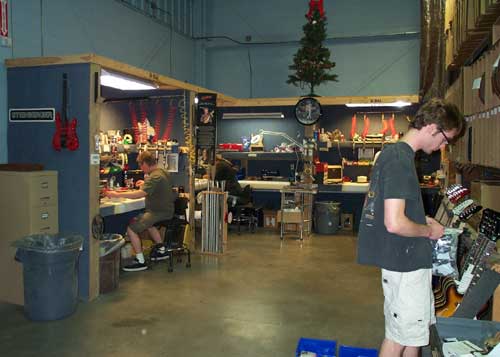
Steinberger USA production. Note the red GM &
sign on the wall to the left.
That's Neal Logdahl on the left, Jimmy Ellis in the middle/back, and Dave
Mahaffey on the right/foreground.
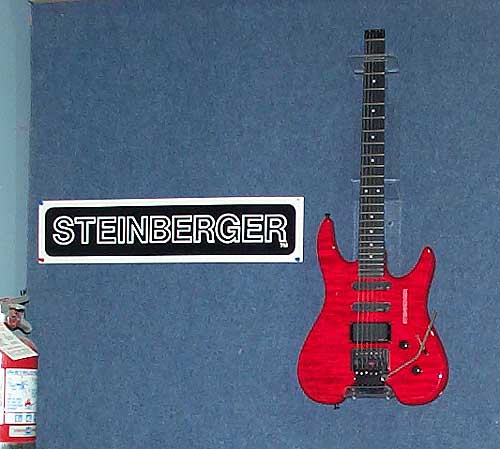
Close-up of the red NOS GM & sign on the assembly area wall.
We got to see several finished
GM's, as well ones in various stages of assembly.
Also saw one of the 12's assembled.
It was fun to talk to these guys about issues they've had with setups,
TransTrems, going over features, details, etc. We
chatted there for at least 15 minutes.
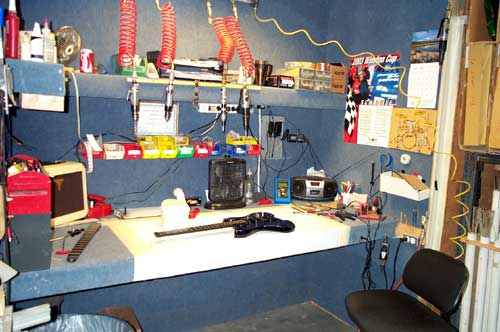
Photo of one of the assembly stations.
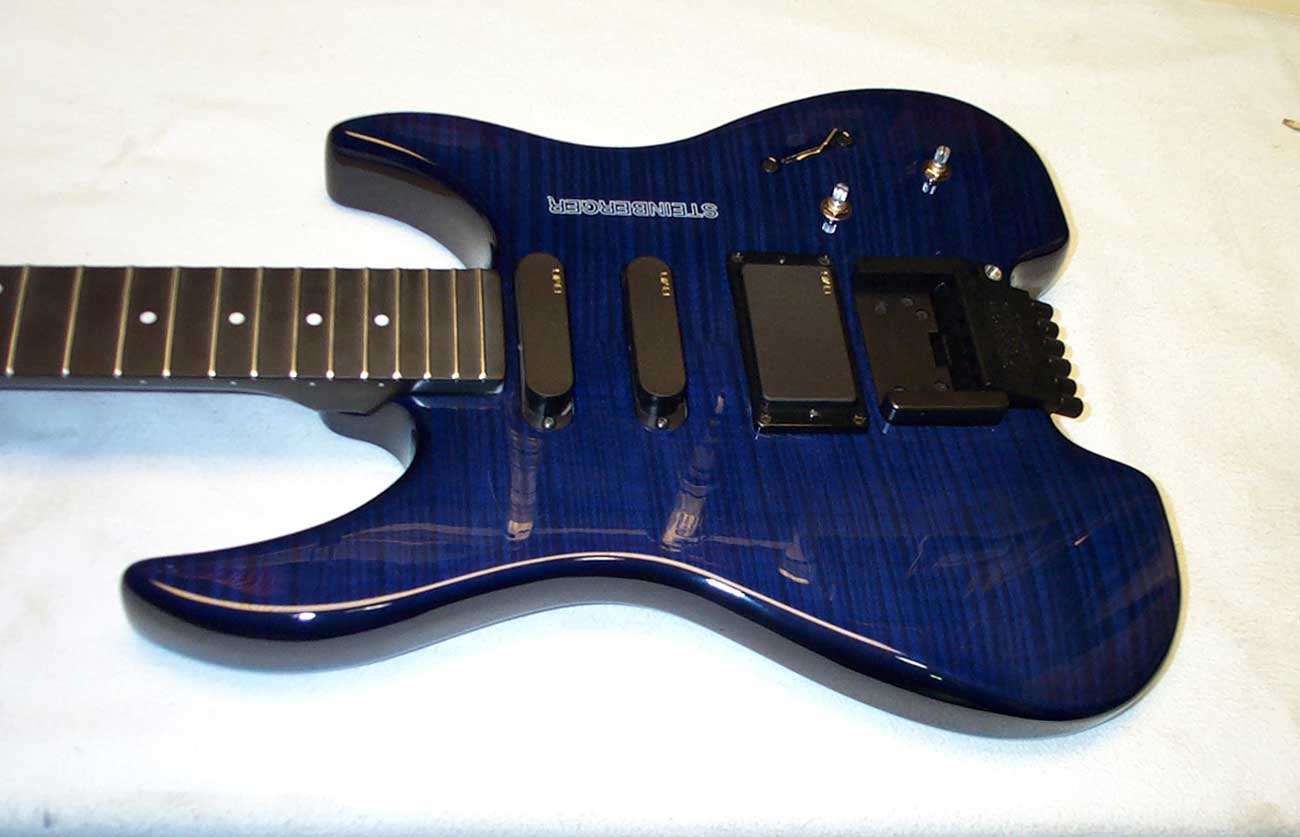
Close-up of the translucent blue GM4S from above being assembled.
Note the nice flamed maple top. Click on image for a larger detailed view.
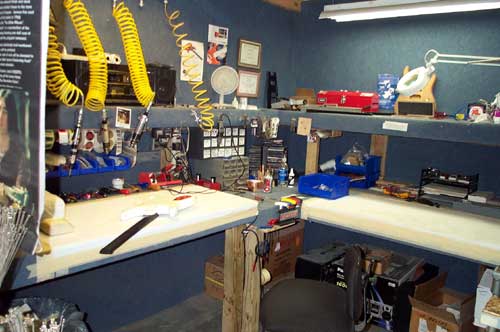
Another assembly station. This time it's work on a white GM
12 string.
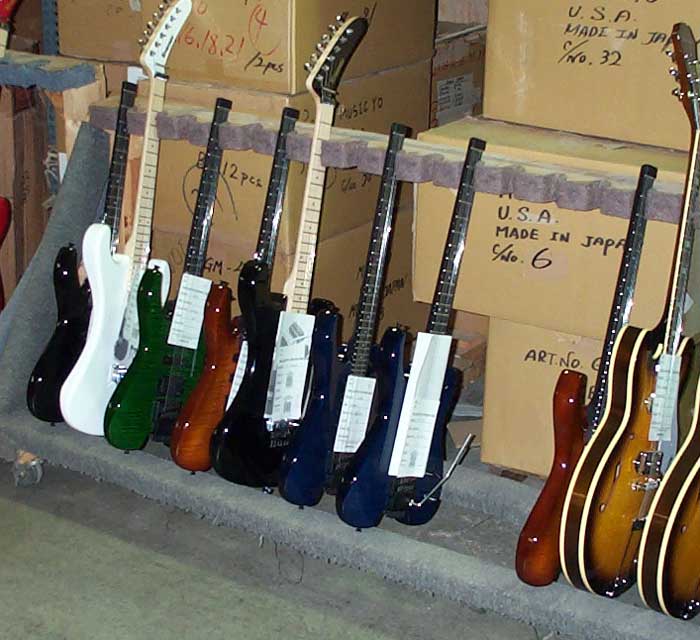
The working assembly rack. Mostly Kramers of the left, John
Lennon's on the right, with mostly 'bergers in the middle.
Click on image for a larger detailed view of the Steinbergers.
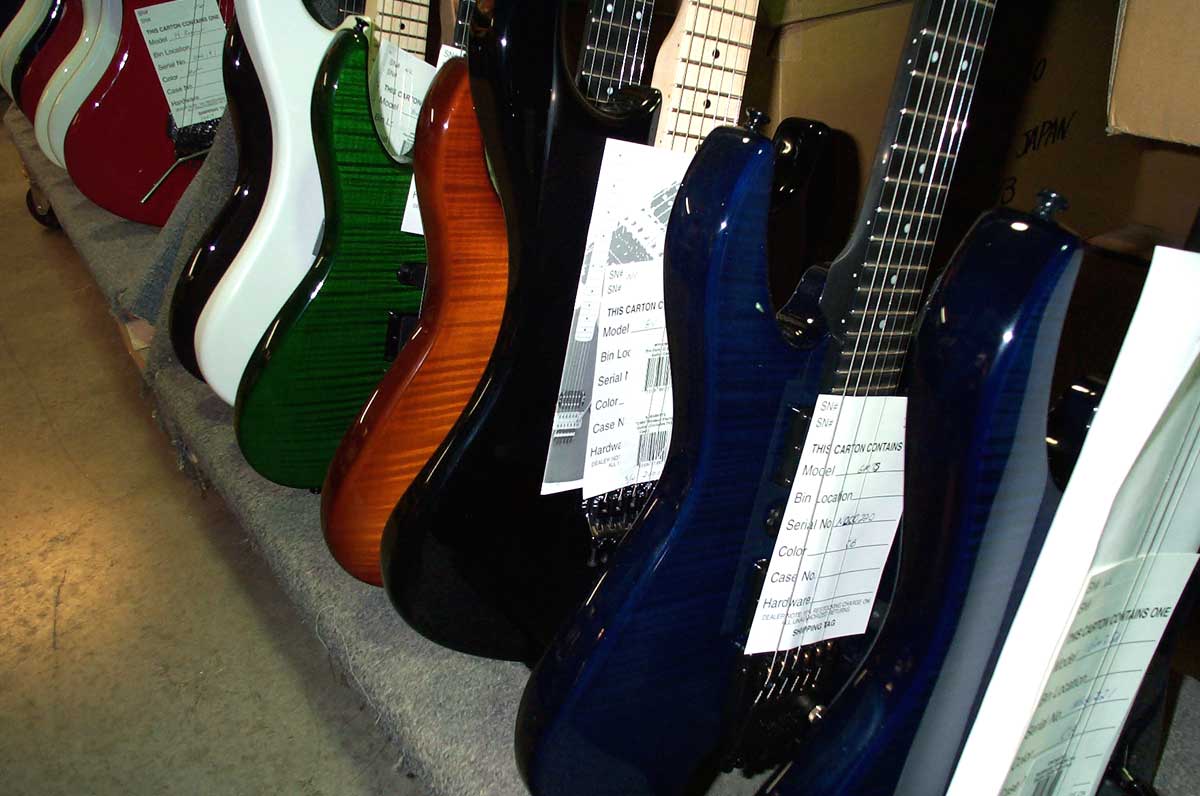
Another shot of the soon-to-be finished product.
Click on image for a larger detailed view.
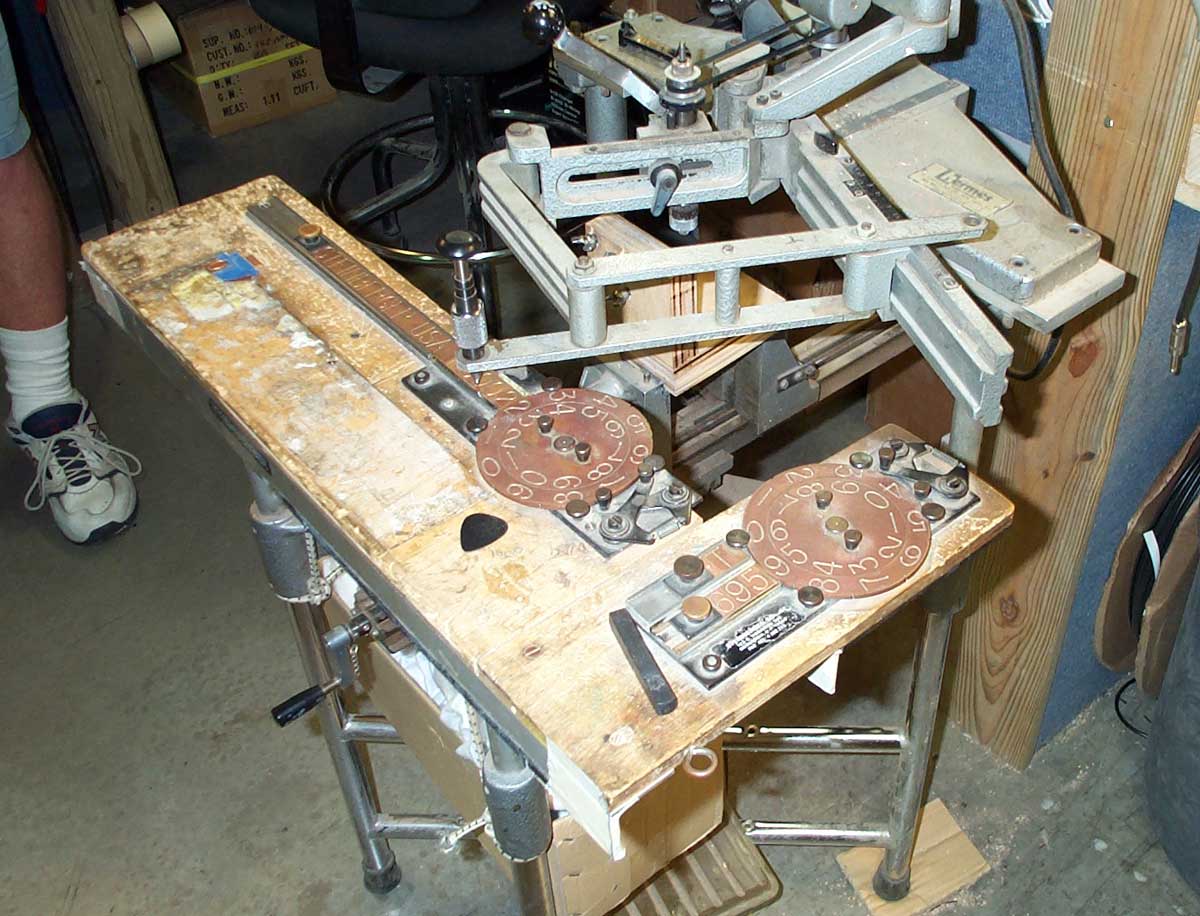
The Steinberger serial number engraving machine.
This same machine was first used in Newburgh and all through the Nashville
years.
The left side is for bolt-ons; the right side for L's
Click on image for a larger detailed view.
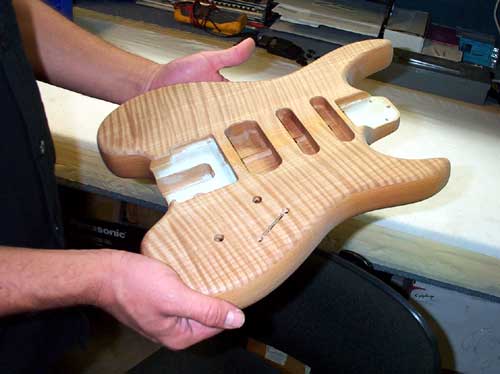
An unfinished flamed maple GM4 body.
At this point Richard showed me
the old Steinberger parts bin stored against a back wall.
I decided to start going through that while Richard met with Phil.
As you may know Phil milled the 12 string headpieces, and they wanted to talk
to him about perhaps working on future products/hardware as well.
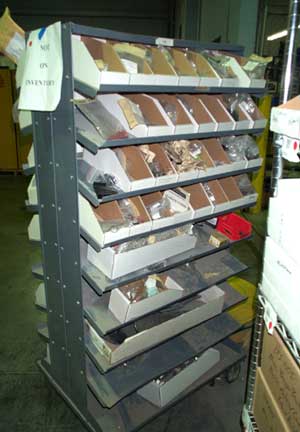
The unorganized parts bin.
After probably 10 minutes Phil
and Richard came back, and we walked over to the office building.
This is where the MusicYo programming and customer support staff
are located, and I chatted with several of them. In
the last 3 years I’ve had email contact with many of them, so again it was nice to
put faces with names.
Last stop in the office was the conference room. There we got to see 2 new Steinberger prototype instruments. Sorry, no photos and I’ve agreed to stay mum for now. Just let me say that Ned has had almost 6 years to think about changes and improvements to the line, and it appears he’s picking up right where he left off.
Phil had a meeting with Ned at NAMM a short time later. He headed out while Richard and I headed back to the plant. We talked more about various things. Of note is that we looked over an unfinished bound GM body and a prototype of the new XQ's. There are 4 GM's close to being finished. One is for a friend of Henry Juskiewicz (president of Gibson) who'll be doing some intricate artwork and inlay work on it. The other three will be up sale on MusicYo. They are hoping to green light the XQ's in the upcoming weeks and have them available for sale in 6-8 weeks. Richard had some questions about details and some decisions they had to make. I was (like every part of my trip) happy to give my thoughts & input on them. He also confirmed the wood bodied GL's (model name still undecided) will happen soon too.
Now was the time to really get into the parts. There was parts bin mentioned earlier as well as two palettes back in the storage shed. Again the shed is a smaller building two stories high right behind the plant along the side property line. The FedEx trailer is blocking the view of it in the pic above. It’s got large shelves for storage, and this is where they put everything they don’t need, but don’t want to throw out. Seems they save almost everything "just in case". Luckily they already had the Steinberger palettes on the floor. The palettes weren’t huge, just standard wood ones with miscellaneous small to medium boxes stacked randomly about knee high. I jumped right in.
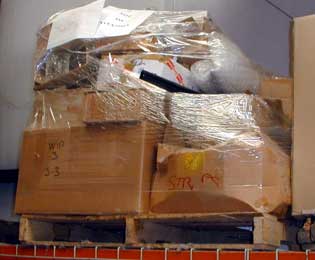
Previous pic Akers sent me of the larger palette of Steinberger parts.
Parts, parts everywhere! It was a trip going through these boxes – a broken TransTrem here, some bass bridge parts there. I didn't take any photos, but you get the general idea. I got the two palettes organized into three groups: stuff we’d probably never need, stuff I’d like to take with, and stuff that should stay for production or immediate sale. This took the better part of two hours as some boxes were all one item, whereas others had various parts in them which had to be sifted through.
When
I say parts never
needed this included what appeared to be Kramer and/or Tobias parts,
damaged Spirit parts, things like unplated Z-Trem or JamTrem plates (not sure
which), and even some things even I had no clue about.
I then consolidated those on one palette to stay in the shed and put the
rest on the other palette. This
they fork-lifted back into the plant for
me to go through further (where it was nice and air conditioned).
I’d
add that the guys there were great. They
came back to check on me frequently (it was a bit crispy back there to be sure), and made
sure to invite me to the employee cookout they had going.
I did sit down with them and had a Diet Coke before heading
back in to the production area to spend more time on the parts.
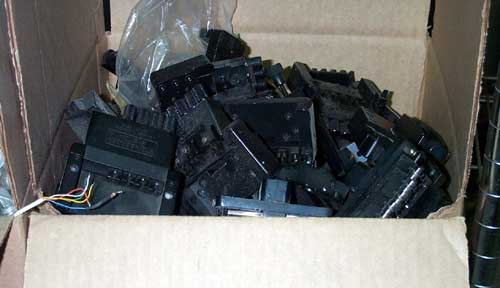
Discarded bridges from current production.
These are blemished or damaged and used for parts when necessary.
Back inside I poured through everything. Again anything that we might need or I’d gotten specific requests for I threw into boxes to take with me. This included parts from discontinued hardware – things like older v3 bass saddles. Other more esoteric items I haven’t gotten specific requests for (like S-Trem tuner covers) I set aside to put back into the parts bin. I then went through the standing parts bin, taking some stuff and organizing the rest.
The
bin was two sided, but I got everything reorganized into one side so they could store it
against the wall. I tried to
set it up somewhat logically (guitar bridge parts on the top row, bass on the
next, string adapters on one, electronics on yet another). I
went ahead
and labeled the boxes for future access. I
also took some detailed pics for our reference as well. That way we can direct them to
the proper box if we need something down the road.
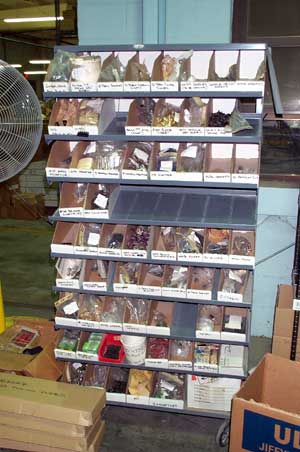
The now organized & labeled parts bin.
During this time Debbie Orsland stopped by. For those who might remember, Debbie started as an accountant with Steinberger back in Newburgh, and was with the company until ’98 when the ended production and transferred her into Gibson corporate. She’s now with Baldwin in the dealer accounts area if I recall correctly. I had planned to go over and meet her at her office, but I knew I’d be tied up at the plant all day and called her to say so. She agreed to drive over and meet me.
It was nice to finally meet her, as she’s been a great help from the inside. This was especially so in the beginning of our group when she’d direct us inside the organization to the right people - before MusicYo had a firm handle on things. She also personally kept the serial number logs and was key in getting them released. I must say it seemed like she got a kick grabbing parts out of the boxes and trying to figure out what they were, since she alone dealt with parts orders while in Nashville. We even ran across some from before her time! Since Steinberger is where she started she’s definitely got a soft spot for it.
Again I
did find a few parts they could use now. These
included a whole bunch of original leg rests (not the Spirit type). These I boxed and labeled for them to take over to the
MusicYo warehouse (I never got over there by the way).
I also found nearly 300 trem arms without locking nuts. I didn't
know which type they were, though it now appears they are for JamTrems.
I also found the top tuner assemblies for maybe 30+ DB bridges and
labeled those.
It was
now about 4:00 PM and I showed Richard
what I’d done. He thanked me profusely several times for helping them out.
I filled out a general inventory sheet, he took some pics of the
boxes, and we hauled them out to my car. Mission
#1 accomplished!
NOTE - I still have yet to inventory all of the parts and negotiate prices with MusicYo. When that's complete I will post a detailed list with prices to the Yahoo! Group. So please refrain from parts emails for now.
I
showered at the room (I needed it!) and called Yahoo! Groups member Brady Bargenquast (aka
bbargenquast) on his cell phone.
Brady has been a long time member on the Yahoo! Group (those are all his L’s lined up
against the wall in that one pic) and we’ve chatted by email on numerous
occasions. He's now with Gibson
Labs and he invited me over to the Gibson Café.
There he showed me some of the products he’s working on and we
then talked (about mostly Steinbergers) for at least an hour.
Like all of the guys from our group I’ve talked to (in person or by
phone) it's been fun and Brady was no exception.
Joined Phil and Bruce for a late dinner at Hooters and spent most of the evening chatting and drinking there. Good time to be sure, but I did have to watch myself for the big day on Saturday.
Click here to read Part 2. . .